
Why modern SAP delivery needs release governance—not merely successful imports
Modern SAP delivery needs a control tower that coordinates change, quality, approval, deployment and evidence across the landscape.
Ask an SAP team how it manages releases and the first answer will often be about transports: which tool moves them, who approves them, when the import window opens and how the queue is sequenced.
That answer made sense when the technical center of gravity was a largely ABAP-based landscape. Transport control was release control.
But the landscape has changed.
A business release can now combine an ABAP change in ECC or SAP S/4HANA, an SAP BTP application, an integration flow in SAP Integration Suite, analytics content in SAP Analytics Cloud, a data model in SAP Datasphere, configuration changes and automated tests. The work may also pass through SAP Cloud ALM, Jira, ServiceNow or Azure DevOps before it ever reaches production.
Every individual artifact can move successfully and the release can still fail.
The wrong versions may be combined. A dependent integration may arrive late. An approval may exist without the evidence that justified it. A test may have passed against an earlier build. A production deployment may complete, but nobody may be able to reconstruct the complete decision trail later.
That leads to a distinction SAP leaders should make clearly:
A successful transport is not automatically a successful release.
Transport management remains essential. It is simply no longer enough.
The landscape moved. The operating model often did not.
Many SAP organizations now operate a hybrid delivery landscape with a transport-centered process inherited from an earlier era.
The usual response has been to add coordination around the transport process: spreadsheets, release calls, email approvals, change tickets, screenshots and manually assembled audit packs. This can keep a release moving, but only through significant human effort. It also creates a dangerous illusion of control. The process looks governed because it contains many checkpoints, while the evidence behind those checkpoints remains fragmented.
Transport management answers important technical questions:
- Which artifact is moving?
- From which system to which target?
- In what sequence should it be imported?
- Did the technical movement complete?
Release governance must answer a broader set of business and operational questions:
- Why is this change being released?
- Is the exact release candidate ready?
- Have the required quality checks passed?
- Were the right approvals given against the right evidence?
- Are cross-application dependencies synchronized?
- Can the organization prove what happened after the fact?
The difference is not semantic. One controls movement. The other controls production risk.
Release governance is the connective tissue
When people hear “governance,” they sometimes imagine more meetings, more approval layers and a larger change advisory board. Good release governance should produce the opposite result.
It should turn policy into an executable delivery flow. Low-risk changes should move with less manual coordination. High-risk changes should receive additional scrutiny based on evidence, not instinct. Teams should spend less time collecting status and more time resolving the exceptions that matter.
For modern SAP delivery, six connections are especially important.
1. Business intent to technical change
A requirement or feature should remain connected to its transports, application packages, integration artifacts, tests and deployment history. Without that link, teams can confirm that something moved but struggle to prove that the intended business change was delivered completely.
2. Dependencies across SAP technologies
The production outcome may depend on artifacts from several delivery mechanisms. Release governance must treat the release as one coordinated unit, even when its components use different pipelines and technical deployment tools.
3. Quality evidence to the release decision
A green approval should not be a substitute for evidence. Static analysis, ABAP Unit, ATC, automated regression testing, security checks and functional results should be associated with the actual release candidate and available at the point of decision.
4. Approval to policy
Not every change needs the same path. An urgent fix, a routine low-risk change and a regulated release may require different validations and sign-offs. The workflow should apply the correct policy consistently and retain the resulting decision trail.
5. Deployment activity to an audit-ready record
Teams should not have to rebuild the story of a release from emails, tickets and screenshots. The record should be produced as the work happens: who approved, which checks ran, what was deployed, when it moved and what the outcome was.
6. Production feedback to continuous improvement
Release governance should not stop at deployment. Operational results, failures, rollbacks and recurring delays should inform future release decisions. Otherwise, every release begins without the benefit of the last one.
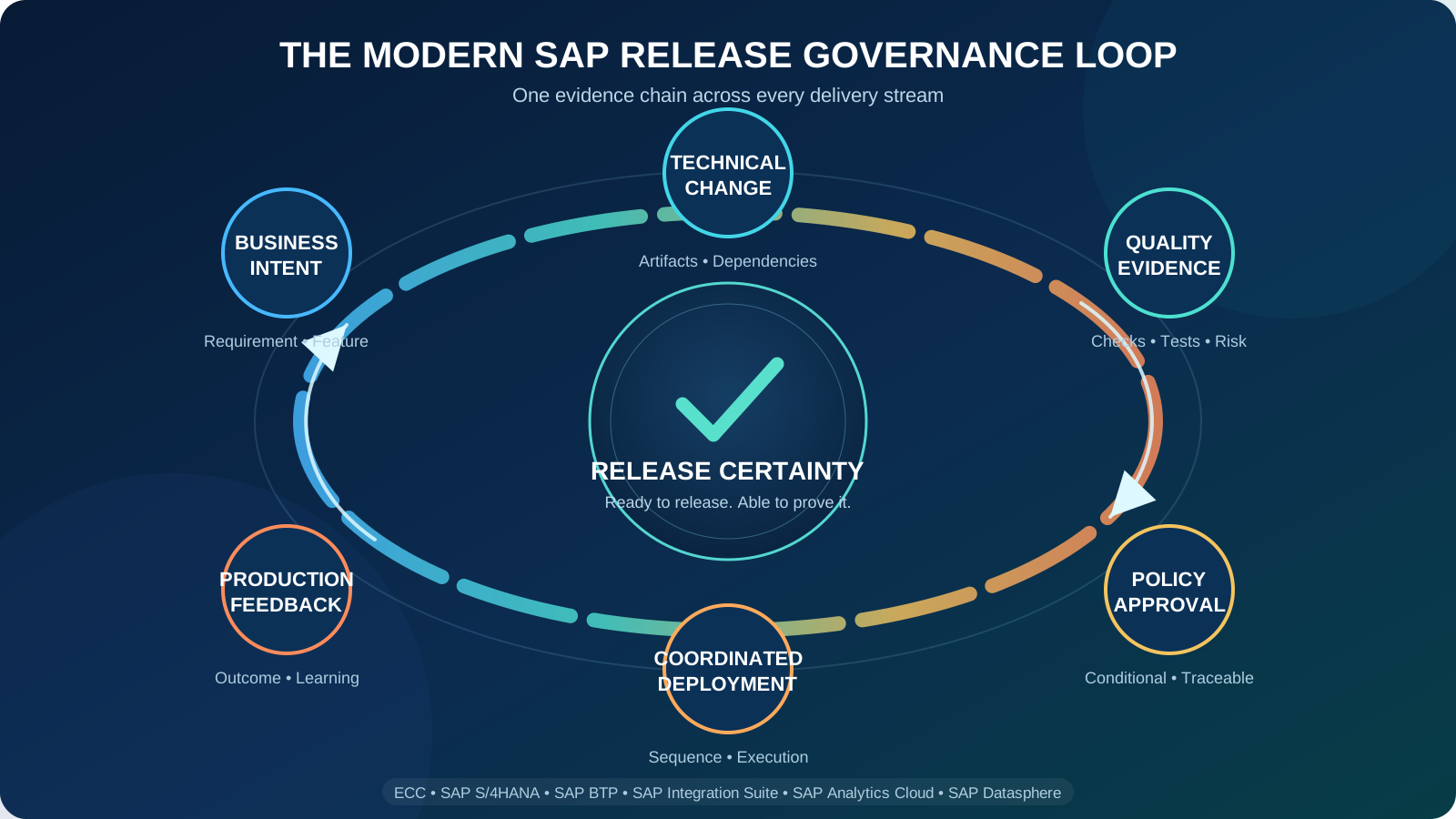
Release governance creates a continuous evidence chain—from business intent to production feedback—across every SAP delivery stream.
Where SAP Cloud ALM fits
SAP Cloud ALM is becoming a central system for managing implementation activities, requirements, features, testing and deployment planning. For organizations adopting it, SAP Cloud ALM should remain the system of record for the lifecycle.
The next question is practical: how does the organization connect that lifecycle record to the execution happening across ECC, SAP S/4HANA, SAP BTP, SAP Integration Suite and other parts of the landscape?
That is not a replacement discussion. It is an integration and operating-model discussion.
SAP Cloud ALM can hold the feature, release context and lifecycle status. A complementary SAP DevOps execution layer can automate validations, coordinate deployments, enforce conditional workflows and return technical status, test results and release evidence to the lifecycle.
The result is a stronger model:
- SAP Cloud ALM provides program and lifecycle visibility.
- Delivery tools execute the technical movements appropriate to each SAP technology.
- Release governance connects the two with policy, automation and evidence.
This matters because a system of record is most valuable when the information in it reflects what actually happened—not what someone manually updated after the release call.
What good looks like
A governed SAP release should give every stakeholder a different view of the same truth.
The business owner can see whether the feature is ready. The release manager can see dependencies, exceptions and approvals. Developers can see the failed check that requires action. The deployment team can see the correct sequence. An auditor can reconstruct the evidence without asking the delivery team to assemble it months later.
In practical terms, that means:
- One traceable release record connects the business change to every relevant artifact.
- Entry and exit criteria are evaluated consistently at each stage.
- Quality results are tied to the version being promoted.
- Approvals are conditional on policy and evidence—not simply calendar milestones.
- Deployment across multiple SAP technologies is coordinated as one business release.
- Evidence is captured automatically during delivery.
- Exceptions are visible early enough to act on them.
This is more than control. It is also how organizations create speed safely.
When policy is automated and evidence is available in real time, teams do not need to slow every release to protect the organization. They can let routine, well-understood changes flow while focusing attention on changes with greater dependency, compliance or production risk.
Start with one value stream, not an enterprise transformation
Moving from transport management to release governance does not require a big-bang program.
Start with one representative SAP value stream and ask five questions:
- Where is the business intent recorded?
- Which technical artifacts must move together for that intent to be delivered?
- What evidence is required before each stage?
- Which decisions are still made through meetings, email or spreadsheets?
- What must be provable after production deployment?
Map the answers. Define the release entry and exit criteria. Automate one meaningful gate at a time. Then measure whether lead time, manual coordination, failed checks and evidence preparation improve.
The objective is not to reproduce an old approval process in a new tool. It is to remove unnecessary work while making the controls that matter more reliable.
From transport completion to release certainty
ReleaseOwl was built for this gap.
It provides an SAP-native DevOps execution and governance layer across ECC, SAP S/4HANA, SAP BTP, SAP Integration Suite, SAP Analytics Cloud and SAP Datasphere. It connects packaging, validations, approvals, deployment automation, testing and release evidence into a governed delivery flow.
For SAP Cloud ALM customers, the operating principle is straightforward: SAP Cloud ALM remains the system of record. ReleaseOwl extends it with enterprise release governance, automation and audit-ready delivery.
This is not about discarding existing investments or adding another dashboard. It is about connecting the delivery landscape so that the organization can answer a more valuable question than “Did the transport import?”
The question is:
Are we ready to release—and can we prove it?
If your SAP delivery model still depends on manual coordination around transport movement, it may be time to evaluate the missing release-governance layer.
Request a ReleaseOwl demonstration to see how governed SAP delivery can work across your landscape.
For organizations using SAP Cloud ALM, you can also explore the ReleaseOwl Free Tier for your first 100 SAP Cloud ALM Features.




Leave A Comment